




Azelaic Acid Vs Vitamin C

Azelaic Acid Vs. Vitamin C - Which Is Right For Your Skin?
The secret to brighter, more even-looking skin isn’t choosing between azelaic acid or Vitamin C - it’s using azelaic acid and Vitamin C. Both ingredients are celebrated for their ability to visibly diminish the appearance of dark spots and uneven skin tone, but they each bring something unique to your routine. Together, they make a complementary pair that can help amplify your skin’s natural radiance. Here’s what you need to know about using these two powerhouse ingredients together in your skincare routine.
What Is Azelaic Acid in Skincare?
The molecular structure of azelaic acid makes it a dicarboxylic acid, so it belongs to neither the alpha-hydroxy acid (AHA) or beta-hydroxy acid (BHA) familyi. Azelaic acid molecules are larger than those of many other acids, qualifying it as a relatively gentle exfoliator that is well-tolerated by most individuals with sensitive skinii.
Azelaic acid is a multi-purpose ingredient that helps reduce the look of redness and dark spots while also helping clear pore congestion, all without causing the skin to feel irritated. With antioxidant properties, azelaic acid helps defend skin against the visible effects of environmental aggressors.
What Type Of Skin Is Azelaic Acid Best For?
Azelaic acid is one of the gentlest acids, making it compatible with virtually all skin types. Its benefits have earned it a reputation as an excellent ingredient for individuals struggling with sensitive and/or acne-prone skin.
Azelaic Acid can help:
- Achieve a brighter-looking complexion
- Improve the appearance of uneven skin tone
- Lessen the visibility of dark spots and post blemish discoloration
- Clear pore congestion without causing the skin to dry
- Improve skin redness
What Is Vitamin C in Skincare?
Vitamin C, also known as ascorbic acid, is one of the most well-researched ingredients in skincare. Rather than working as an exfoliant, Vitamin C is recognized as one of the most potent antioxidants found in the skin.iii
So, how does Vitamin C benefit your skin? It is widely used to help diminish the appearance of skin dullness and dark spots; helping support a brighter-looking complexion. Beyond helping to improve the look of the skin, Vitamin C can also help the skin defend against environmental aggressors.
What Skin Type Is Vitamin C Best For?
Vitamin C can be a beneficial ingredient for individuals with varying skin types, particularly those who are aiming to:
- Lighten the appearance of dark spots and even skin tone
- Help with skin dullness - brightens skin for a radiant glow
- Neutralize environmental aggressors (stressors)
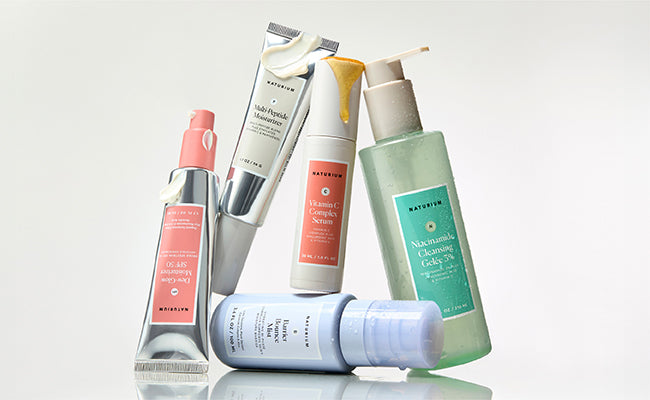
It’s worth knowing that free L-ascorbic acid — the purest form of Vitamin C — requires a low pH environment for effective absorption into the skin, which can occasionally cause mild sensitivity or tingling, particularly for those with reactive skiniv. The good news is that Vitamin C is still accessible for sensitive skin types, it simply comes down to how it’s formulated. Naturium’s Vitamin C Complex Serum was designed with exactly this in mind. The formula features L-ascorbic acid conjugated to gold particles, a delivery system that stabilizes the ingredient and helps control its release, reducing the direct skin contact that can trigger sensitivity. It’s also powered by Sodium Ascorbyl Phosphate, a gentle, stable Vitamin C derivative that works effectively at a neutral pH. No low-pH system required.
Is Azelaic Acid Or Vitamin C Better For Uneven Skin Tone?
If you’re trying to choose between azelaic acid or Vitamin C for helping to improve the look of dark spots, overall radiance, or even aging skin, here’s good news: you can use both to achieve your goals.
Can You Use Azelaic Acid and Vitamin C Together?
Yes, using azelaic acid and Vitamin C together can offer a variety of benefits for your skincare routine. In fact, using Vitamin C and azelaic acid together makes for a powerful retinol alternative. You can use azelaic acid and Vitamin C together up to twice daily, as long as you confirm that your skin tolerates this level of frequency without issue. The combination is safe for virtually all skin types.
How Do You Layer Azelaic Acid And Vitamin C?
In terms of learning how to layer azelaic acid and Vitamin C for the best results for your skin, much of it comes down to personal preference. One option is to choose a topical that combines both ingredients in a single formulation, making it a quick and simple addition to your daily skincare routine.
You can also layer the individual ingredients if you prefer. It is often suggested that you apply Vitamin C in the morning, largely because it helps the skin defend against environmental aggressors (stressors). You can also use azelaic acid in your morning regimen or apply it in the evening instead. As always, consider the consistency of the formulas you are using: for optimal absorption, start with the products with the thinnest consistency and work your way through thicker formulas.
Which Do You Apply First — Azelaic Acid Or Vitamin C?
As a general rule, apply serums and treatments from thinnest to thickest. Vitamin C serums are typically lighter in consistency and absorb quickly, making them ideal as a first step on clean skin. Azelaic acid formulas, which often come in gel or cream textures, are applied after, allowing both ingredients to absorb fully and work effectively without interfering with one another.
A simple routine might look like this: cleanser → Vitamin C serum → azelaic acid → moisturizer → SPF. And for the evening routine, just remove the SPF step.
How Often Can Azelaic Acid And Vitamin C Be Used Together?
Azelaic acid can be used up to twice a day, especially because it is counted among the gentler acids. Vitamin C is commonly suggested for morning use but can be used both morning and evening.
When it comes to brighter, more even-looking skin, you don’t have to pick a side. Azelaic acid and Vitamin C are two of skincare’s most well-researched ingredients, and their differences are precisely what make them such a powerful pair. While azelaic acid brings gentle exfoliation with benefits for pore congestion, redness, and dark spots, Vitamin C delivers visible skin brightening assistance. Together, they address uneven skin tone, dullness, and the look of dark spots from multiple angles.

ihttps://pubmed.ncbi.nlm.nih.gov/24280644/
iihttps://pmc.ncbi.nlm.nih.gov/articles/PMC10809820/
iiihttps://pmc.ncbi.nlm.nih.gov/articles/PMC5605218/
ivhttps://www.mdpi.com/1420-3049/29/19/4604
DISCLAIMER: Lab Journals are intended to help educate on specific ingredients and skin care topics. Our articles are written to be informative and informational.
Please note any Naturium products with referenced ingredients are formulated for Cosmetic Use Only and NOT intended as replacements for physician pharmaceutical product recommendations.


Leave a comment
This site is protected by hCaptcha and the hCaptcha Privacy Policy and Terms of Service apply.