




Do Exosomes in Skincare Actually Work? 10 Myths Debunked

So, do exosomes in skincare actually work? The honest answer is more nuanced than a simple yes or no. Early research is promising, especially around skin renewal, firmness, texture, recovery, and signs of aging, including the look of fine lines and wrinkles, but exosome research is still evolving. And not every product marketed with exosome technology is created the same way.
Let’s separate some of the biggest exosome skincare myths from what we actually know. Because depending on where you look, they’re either the future of skincare science or another trend that hasn’t earned the hype.
Author: Amber Smith
Published August 28, 2026
What Are Exosomes in Skincare?
Think of exosomes as tiny messengers. Naturally occurring exosomes are microscopic extracellular vesicles released by cells that carry biological “cargo,” including proteins, lipids, and nucleic acids, from one cell to another. That cargo is part of how cells communicate.
In skincare, exosome-inspired technologies are being explored for their potential to support processes associated with healthier-looking, more rejuvenated skin.
Want the full science lesson? Read our guide to What Are Exosomes in Skincare?, where we break down exactly how they work and where they fit into your routine.
Myth #1: “Exosomes in Skincare Are Just Marketing Hype”
Let’s address the elephant in the room: there is definitely hype around exosomes. But calling them just marketing isn’t fair either.
What the Research Actually Shows (Honest Take)
Are there clinical studies on exosome skincare? Yes, although the body of research is still relatively small as it is an newer ingredient in the skincare industry.
A 2024 systematic review identified nine studies evaluating topical exosomes that met its inclusion criteria. Researchers reported promising findings related to collagen, skin repair, texture, firmness, wrinkles, and overall skin quality. The authors also emphasized that more research is needed.
A separate 2025 review in the Journal of Drugs in Dermatology similarly described exosomes as promising for cosmetic dermatology while highlighting ongoing challenges involving sourcing, standardization, delivery, and regulation.
Translation: there’s real science here, but we’re still learning. Be skeptical of anyone promising that exosomes will completely transform your skin overnight.
Myth #2: “All Exosomes Are the Same”
False. Where an exosome or exosome-like technology comes from can affect its cargo, manufacturing, consistency, and how it’s ultimately used.
Plant-Derived vs Human-Derived vs Animal-Derived Exosomes
Human-derived exosomes studied in aesthetic medicine may come from sources such as platelets, fibroblasts, or mesenchymal stem cells. Plant-derived extracellular vesicles, sometimes called plant exosomes or exosome-like nanovesicles, are another emerging area of research. And extracellular vesicles can originate from many other biological sources.vii
This is why a label that simply says “exosomes” doesn’t tell you the whole story. The source and formulation matter.
Why Naturium Uses Biomimetic and Plant-Derived Exosome Technology
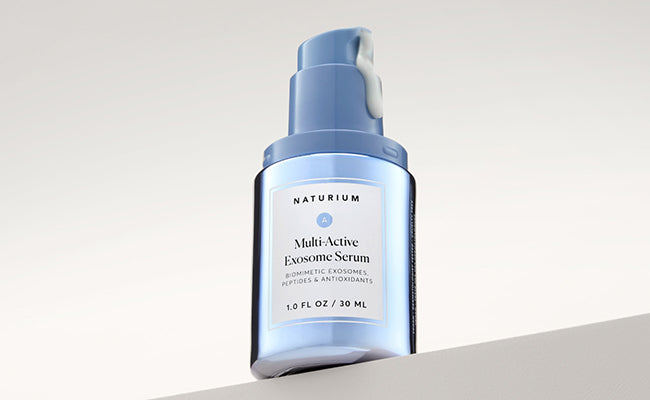
Naturium’s Multi-Active Exosome Serum takes a different approach, combining vegan biomimetic exosome technology with plant-derived exosome technology rather than relying on human-derived exosomes.
Biomimetic technology is designed to mimic aspects of natural exosome delivery while allowing greater control over the formulation and its selected “cargo.” For Naturium, that means pairing the technology with ingredients chosen specifically to help support visibly firmer, smoother, brighter-looking skin.
Myth #3: “Exosomes Are Just Rebranded Stem Cells”
Are exosomes the same as stem cells? No. Stem cells are actual living cells. Exosomes are tiny extracellular vesicles that cells release to communicate with other cells. Think of the cell as the sender and the exosome as the message being delivered.
The confusion makes sense because many exosomes studied in dermatology are derived from stem-cell cultures. But the exosome itself isn’t a stem cell.
Myth #4: “You Can’t Use Exosomes Without Microneedling”
This myth comes from a real issue: getting ingredients through the skin barrier is difficult. But saying exosomes only work with microneedling goes too far.
Injectable vs Topical Exosomes: What’s Different
Procedures like microneedling create temporary microchannels in the skin, which changes how a topical formula can penetrate. That’s one reason exosome products have become popular alongside professional aesthetic procedures. While they are a dynamic-duo for aging skin, this does not exclude topical exosomes from improving the look of skin independent of microneedling.
An at-home topical serum has a different job. It’s formulated to be applied directly to intact skin as part of your regular skincare routine, without needles or an in-office procedure.
What Human Topical Studies Actually Show
Here’s where it gets interesting: topical exosomes have been studied without microneedling.
The 2024 systematic review found studies evaluating topical exosome applications and reported promising results, including improvements in measures of facial aging and sensitive-skin symptoms. (However, the formulations and study designs varied significantly, and none of the studies evaluated Naturium’s formula.)
So no, you don’t need microneedling to use and see skin benefits from a topical exosome serum. But we should also note that applying a topical serum at home is not equivalent to a professional procedure.
Myth #5: “More Exosomes = Better Results”
Skincare loves a big number. But with exosomes, more isn’t automatically better.
Why Formulation Quality Matters More Than Count
Researchers have identified standardization of dosing, potency, purification, stability, and manufacturing as some of the biggest unanswered questions surrounding exosome technology.ii That means an impressive-sounding exosome count alone doesn’t tell you whether a formula is effective.
Pay attention to the entire formula: the type of technology being used, what else is in the serum, how it’s formulated, and whether the finished product has been tested.
As for how often you should apply an exosome serum, follow the directions for your specific formula. Naturium Multi-Active Exosome Serum is designed for daily use and can be applied morning and night.
Myth #6: “Exosome Serums Aren’t Worth the Price”
Are exosomes worth the price? That’s harder to answer when some exosome serums cost hundreds of dollars.
What You’re Actually Paying For (And What You Don’t Need To)
Advanced ingredients and formulation technologies can be expensive to develop, but a higher retail price doesn’t automatically mean better results.
Research suggests looking for transparent sourcing, thoughtful formulation, complementary ingredients, appropriate packaging, and testing on the finished formula.
Naturium Multi-Active Exosome Serum is $27, making advanced, vegan exosome technology accessible without the luxury-level price tag. If you’re searching for the best exosome serum under $50, what really matters is the formulation, the ingredients inside it, and the results it can demonstrate.
Myth #7: “Exosomes Aren’t Regulated But the FDA Hasn’t Approved Any”
This one needs some context because “FDA approved” means something very different for a drug than it does for your face serum.
Cosmetic Regulation vs Drug Approval: What It Really Means
In the U.S., cosmetics generally do not go through FDA premarket approval, with the exception of certain color additives. Cosmetic companies are nevertheless legally responsible for product safety and proper labeling.
FDA separately stated in 2019 that there are no FDA-approved exosome products for treating diseases or conditions and has warned consumers about unapproved exosome products marketed for medical treatment.i That’s an important distinction from cosmetic skincare products like Naturium’s Multi-Active Exosome Serum, which is developed and tested according to Naturium’s rigorous product safety and quality standards.
What about exosome serum side effects? The available topical literature is encouraging but still limited, and formulations vary widely. As with any new skincare product, follow the product directions and patch test first, especially if your skin tends to be reactive.
So, are exosomes safe in skincare? Early research on topical exosomes is encouraging, but the science is still evolving.
Myth #8: “Exosomes Work Overnight”
We love instant gratification too, but skin doesn’t work that way.
Realistic Timelines: When to Expect Results from Exosome Serums
If you’re asking how long does it take to see results from exosome serum, think in weeks, not days.
In Naturium’s consumer perception study, 91% agreed skin looked visibly renewed after one use. After 30 days of daily use, 94% saw a reduced look of fine lines and wrinkles. After four weeks, 100% showed improvement in skin texture and 91% showed improvement in firmness.*
And what is the ideal concentration of exosomes in a serum? Right now, research hasn’t established a universal concentration that guarantees visible results. Standardizing exosome dose and potency remains one of the issues researchers say needs more work.
And there’s another interesting area researchers are starting to look at: hyperpigmentation. Early research has explored exosome-containing treatments for facial discoloration, although we still need much more research before drawing big conclusions.
For anyone navigating skin changes during perimenopause, concerns like dryness, loss of firmness, and visible fine lines and wrinkles may also make emerging skin-renewal technologies like exosomes especially interesting.
*Based on a 34-subject consumer perception study after one use and 4 weeks of use. Individual results may vary.
Myth #9: “Exosomes, Growth Factors, PDRN, and Stem Cells Are All the Same”
They’re often grouped together under the renewing skincare umbrella, but biologically, they’re different things.
Exosomes vs PDRN vs Growth Factors: A Clear Comparison
Exosomes, growth factors, PDRN, and stem cells tend to get grouped together in conversations about skin renewal, but they’re actually very different technologies. A 2026 article breaks down what each one is and how it works. Here’s the simplest way to tell them apart:
| Ingredient/Technology | What It Is | The Difference |
|---|---|---|
| Exosomes | Extracellular vesicles that help carry cargo one place to the next | Think of them as messengers or delivery vehicles that help communicate |
| Growth Factors | Signaling proteins that influence cellular processes | They’re signals, rather than the vesicles that can carry signals |
| PDRN | DNA fragments used in regenerative applications | It’s a DNA-based technology, not an extracellular vesicle |
| Stem Cells | Living cells that can develop into specialized cell types | They’re actual cells; exosomes are particles released by cells |
Myth #10: “You Can’t Use Exosomes With Retinol or Other Actives”
Good news: you don’t have to break up with the ingredients already working for your skin.
The Boost-and-Calm Approach: Exosomes + Retinol + Peptides Together
Can you use exosomes with retinol? Yes. If fine lines and wrinkles are a primary concern, you don’t have to choose between exosomes and a retinoid. Naturium recommends incorporating Multi-Active Exosome Serum into routines alongside other treatment products.
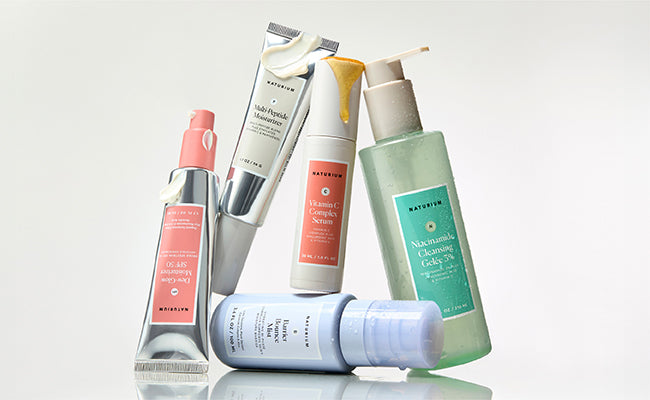
At night, for example, you can cleanse, apply Multi-Active Exosome Serum, follow with Retinaldehyde Cream Serum 0.05%, and finish with Multi-Peptide Moisturizer. In the morning, Vitamin C Complex Serum can be followed by Multi-Active Exosome Serum, moisturizer, and SPF.
Rather than replacing retinoids, vitamin C, or peptides, Multi-Active Exosome Serum can be layered alongside them to create a more comprehensive approach to healthier-looking skin.
How to Choose an Exosome Serum (What to Look For)
By now you’ve probably realized there’s a theme here: don’t shop for exosomes based on hype alone.
Sourcing, Formulation, Price, and Transparency Checklist
Before choosing an exosome serum, ask:
- Does the brand explain the source? Look for transparency about what type of exosome or exosome technology is being used.
- Does the full formula make sense for your skin? Consider complementary ingredients and the overall formulation, not just the exosome count.
- Has the finished product been tested? Look for product-specific clinical or consumer testing when available.
- Are the claims realistic? Be skeptical of dramatic, medical-sounding promises, especially while exosome research is still evolving.
- Does the price make sense? Expensive doesn’t automatically mean effective. A thoughtfully formulated $27 serum doesn’t become less sophisticated simply because it doesn’t cost $300.
The bottom line: The science behind exosomes is exciting, but it’s still developing. Look for transparency, thoughtful formulation, testing, and realistic claims.
Shop Naturium’s Exosome Serum and Complementary Products
Naturium Multi-Active Exosome Serum is designed to work with the ingredients you already know and love. Pair it with Vitamin C Complex Serum in the morning or Retinaldehyde Cream Serum 0.05% and Multi-Peptide Moisturizer at night for a routine that targets multiple signs of skin aging from different angles.
Because the most exciting skincare innovation isn’t necessarily the one that replaces everything that came before it. Sometimes, it’s the one that makes a great routine even better.

The Skincare Ingredient Going Viral That Dermatologists Say Is More Hype Than Science — Charlotte Observer, By Hanna Wickes — https://health.yahoo.com/your-body/dermatology/articles/skincare-ingredient-going-viral-dermatologists-203925120.html
Haykal D, Wyles S, Garibyan L, Cartier H, Gold M. Exosomes in Cosmetic Dermatology: A Review of Benefits and Challenges. J Drugs Dermatol. 2025 Jan 1;24(1):12-18. doi: 10.36849/JDD.8872. PMID: 39761139 — https://jddonline.com/articles/exosomes-in-cosmetic-dermatology-review-of-benefits-challenges-S1545961625P8872X/
Exosomes: Why I’m Not Convinced They’re Worth $400 Yet — BeautyTheStyle — https://beautythestyle.com/exosomes-why-im-not-convinced-theyre-worth-400-yet/
Exosomes, Growth Factors and PDRN Explained: Which Skincare Biotech Ingredient Actually Works — Sacramento Bee, By Hanna Wickes — https://health.yahoo.com/your-body/dermatology/articles/exosomes-growth-factors-pdrn-explained-151641122.html
Ash M, Zibitt M, Shauly O, Menon A, Losken A, Gould D. The Innovative and Evolving Landscape of Topical Exosome and Peptide Therapies: A Systematic Review of the Available Literature. Aesthet Surg J Open Forum. 2024 Mar 19;6:ojae017. doi: 10.1093/asjof/ojae017. PMID: 38633728; PMCID: PMC11023079 — https://pmc.ncbi.nlm.nih.gov/articles/PMC11023079/
What Are Exosomes in Skincare: Get to Know Multi-Active Exosome Serum — The Lab Journal, By Amber Smith — https://naturium.com/blogs/the-lab-journal/what-are-exosomes-in-skincare
Zixuan Sun, Jiali Li, Zhijing Wu, Jiaxin Zhang, Tangrong Wang, Yuzhou Zheng, XueZhong Xu, Wei Ding, Hui Qian, Yulin Tan, Extracellular vesicles and their mimetics: clinical application prospects in medical aesthetics, Burns & Trauma, Volume 13, 2025, tkaf033 — https://doi.org/10.1093/burnst/tkaf033
Hyaluronic Acid, Succinic Acid, and Exosomes in the Treatment of Facial Hyperpigmentation: A Report of Two Cases — Valentina Corvalan, Victor Mercado, Marta Amin — Published: February 03, 2026 — https://www.cureus.com/articles/458775-hyaluronic-acid-succinic-acid-and-exosomes-in-the-treatment-of-facial-hyperpigmentation-a-report-of-two-cases#!/
DISCLAIMER: Lab Journals are intended to help educate on specific ingredients and skin care topics. Our articles are written to be informative and informational.
Please note any Naturium products with referenced ingredients are formulated for Cosmetic Use Only and NOT intended as replacements for physician pharmaceutical product recommendations.

Leave a comment
This site is protected by hCaptcha and the hCaptcha Privacy Policy and Terms of Service apply.